

U.S. organizations spent $102.8 billion on training in 2025. They allocated 4% of that to AI skills. Meanwhile, organizations are pouring $85,000 a month or more into AI tools and planning to increase their AI investment by 92% over the next three years.
The money is going to the machines. Not the humans who need to work with them.
This isn’t a training gap. It’s a fundamental misunderstanding of what’s required to realize the promise of AI to the organization. And the cost of getting it wrong is not a bad quarter. It’s organizational irrelevance.
The numbers don’t lie. But they do mislead.
Here’s what the current landscape looks like. Organizations are spending an average of $874 per learner annually on all training. Training hours per employee actually dropped from 47 to 40 in a single year. Only 27% of firms have a structured AI upskilling program. And 44% of companies reskilled less than 5% of their workforce over the past year.
At the same time, enterprise AI budgets are growing 75% year over year. The average organization is now spending over a million dollars annually on AI tools alone.
One side of the ledger is accelerating. The other is barely moving.
But here’s what makes this worse. Most of what organizations call “AI training” is tool training. How to use the chatbot. How to write a prompt. How to navigate the new interface. That is not reskilling. That is not redesigning work. That is not going to lead to ROI on the AI spend. That is onboarding to software. And it is wildly insufficient for the AI available transforming businesses today.
Training teaches you how to use a tool. Reskilling changes how you think about your work.
The World Economic Forum estimates that 44% of workers’ skills will be disrupted in the next five years. BCG’s research found that half of frontline employees have hit a “silicon ceiling,” stuck at basic AI usage with no pathway to deeper integration.
The distinction between training and reskilling matters because AI agents are approaching PhD-level competence in functional domains. Engineering. Finance. Supply chain. Marketing analytics. Legal research. The work that most knowledge workers spent decades learning to do is becoming table stakes for a well-orchestrated set of agents. The question is no longer “can you do this work?” It’s “can you evaluate, direct, and improve upon what AI produces?”
That requires a different set of skills entirely.
Three types of skills that matter now
1. Human skills. Stop calling them soft.
These are about to become the most valuable skills in any organization. They are also the hardest to develop. Here are the ten that matter most.
Collaboration and facilitation. Aligning humans around decisions that include AI. Managing conflict, creating shared understanding, and enabling teams to adopt new ways of working. The technology is the easy part. Getting people to change how they work together is the real challenge.
Vision and inspiration. Setting direction, motivating change, and using AI to accelerate a compelling narrative, not just efficiency. The leaders who win in this era will not be the ones who automate the most. They will be the ones who inspire their organizations to become something new.
Systems thinking. Understanding second-order effects, dependencies, incentives, and how AI changes a whole process, not just one task. This is the skill that prevents local optimization from creating organizational chaos.
Judgment under uncertainty. Making sound calls with incomplete information. Balancing risk, upside, ethics, and context when the data doesn’t give you a clean answer. AI can generate options. It cannot weigh them against the political, cultural, and strategic realities of your organization.
Problem framing. Defining the real question, constraints, success criteria, and what “good” looks like before you ever prompt. The quality of what AI produces is a direct function of how well the human frames the problem. Most people skip this entirely.
Critical thinking and verification. Interrogating outputs, spotting gaps, testing assumptions, triangulating sources, and knowing when not to trust the model. This is the skill that separates someone who uses AI from someone who is used by it.
Domain discernment. Knowing what matters in your domain: the edge cases, the regulations, the customer nuance, the things that don’t show up in training data. Translating “generic” AI output into “situationally correct” is where deep expertise meets practical value.
Clear communication. Expressing intent and outcomes crisply. Writing, speaking, and translating complexity for different audiences, both humans and machines. In a world of AI-generated content, the ability to communicate with precision and clarity becomes a differentiator, not a baseline.
Prompting and interaction design. Structuring inputs, iterating, giving feedback, and designing workflows where AI is a teammate, not a vending machine. This is the bridge between human skills and technical skills. It is where most people are today. It is not where they need to stay.
Taste and quality standards. Recognizing what’s excellent versus merely plausible. Aesthetic sense, craft, and discernment about coherence, voice, and fit. AI produces “good enough” at scale. Humans define what “great” looks like.
Here’s the truth. When your AI agent can produce PhD-level financial analysis in seconds, the person who wins is the one who knows what to do with that analysis. Who can see what’s missing. Who can connect it to a strategy that hasn’t been articulated yet. Who can walk into a room and make a decision when the data is ambiguous.
2. Technical skills. Beyond the chat window.
Most organizations think “AI technical skills” means learning to prompt. That was 2023. The skill now is learning to build new workflows. Managing agent orchestration. Understanding how to chain tools together to produce outcomes that are 5 to 10 times faster than legacy processes.
More importantly, the real technical skill is learning how to learn. The tools change monthly. Features ship weekly. A 12-week bootcamp is obsolete by week six. The organizations that win here are not the ones with the best curriculum. They are the ones whose people can pick up a new capability on Monday and have it integrated into their workflow by Friday.
This doesn’t come from training. It comes from team-based experimentation and collaborative discovery.
3. Functional skills. The ones your agents are about to master.
Engineering. Finance. HR. Supply chain. Marketing. Product strategy. These are the domains where most of us have built our careers, going deep over years and decades. Where we have created specialization of roles.
AI agents are rapidly closing that gap. Not replacing the need for domain knowledge, but fundamentally changing the nature of what it means to be skilled in these areas. The skill is no longer “I can build this financial model.” It’s “I have the skills to evaluate the model my agent produced, challenge its assumptions, and know when it’s wrong.”
This is where functional expertise evolves from execution to orchestration. The knowledge still matters. But how you apply it changes entirely.
How you actually redesign your work (hint: it is not a training program)
Let’s be honest about something. Most knowledge workers using AI chatbots are already finding ~8 hours of reclaimed time per week. They’re getting drafts faster, research faster, and analysis faster.
Where is that time going?
In most organizations, nowhere visible. It becomes productivity leakage. It doesn’t show up on a balance sheet. It can’t be redeployed because leadership doesn’t know it exists. People are getting faster without the organization capturing any of that value.
This is the starting point for reskilling to redesign work. That found time isn’t a bonus. It’s the raw material for transformation. The new expectation for knowledge work should be clear: one hour a day of experimentation. Hacking your own job with AI. Not as a side project. As a core part of how you work.
The goal is not incremental improvement. It’s 5 to 10x shifts in how work gets done in your function. New workflows. New ways of collaborating. New outputs that weren’t possible six months ago. But this only happens when people have access to the right tooling, understand how to build agentic workflows, manage agents, and work collaboratively as roles evolve beyond traditional boundaries.
Here’s what this looks like in practice.
Monday: Focus and align. The team picks a specific area of their work to “hack” that week. Not a vague goal. A specific process, deliverable, or workflow. Alignment as a group on what they’re trying to improve and why. Embedded AI experts hold office hours to help people get unstuck and push past the chat window into real workflow design.
Tuesday through Thursday: Experiment. People try new approaches. They build agentic workflows. They test. They fail. They iterate. This isn’t theoretical. It’s working on real work with real stakes, just with new methods. The embedded expert is available, not running a class, but coaching in context.
Friday: Show and share. The team comes together. What worked? What didn’t? What produced a genuine breakthrough? The group agrees on the best solutions to scale across the team. The winning experiment becomes next week’s standard operating procedure. Then the cycle starts again.
This becomes a new way of working. Not a training initiative. A working rhythm. A permanent operating cadence where improvement is built into the week, not bolted on as a quarterly workshop.
Skills are the new currency. Not roles. Not titles.
As this experimentation takes hold, something uncomfortable happens. Roles start to blur. The marketing analyst who built an agentic workflow for competitive intelligence is now doing work that used to belong to the strategy team. The finance associate who automated reporting is now spending time on analysis that was previously reserved for senior leaders.
This is where we need HR to support architecting a skills-based organization.
Skills are the new currency in which organizations will trade. Not roles. Not titles. Not org chart boxes.
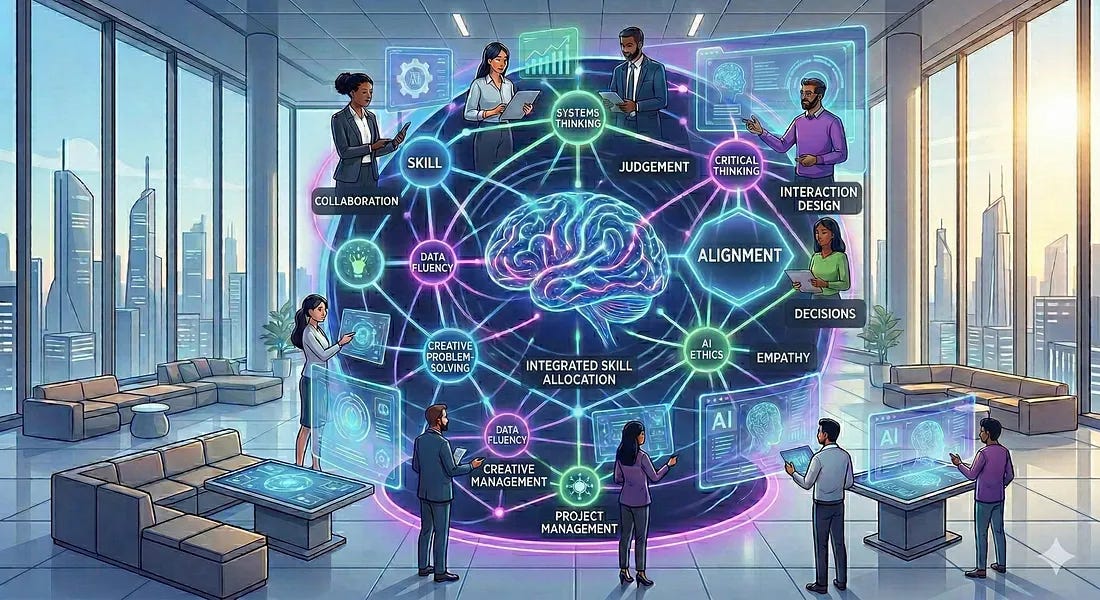
This means building a skills-based architecture that can identify which skills are needed, which skills exist across team members, develop those skills through embedded practice not just courses, test for proficiency in meaningful ways, visualize the skills landscape across the organization and deploy team members on the most important work to the organization.
When you can see skills clearly, you unlock something powerful: an internal skills marketplace. Talent stops being hidden inside departments. The person in operations who taught themself agent orchestration becomes visible to the product team that needs exactly that capability. Work gets matched to skills, not to job descriptions written three years ago for a world that no longer exists.
The wall you’ll hit. And what comes next.
Here’s the truth that most leaders don’t want to hear. Everything I’ve described above is relatively achievable at the department level. A progressive leader with access to the right tools, data and the conviction can transform how their team works.
The hard part is what comes next.
When experimentation works, roles start collapsing across departments, not just within them. The value chain itself starts to compress. And that’s where organizational politics becomes the real blocker. Not the technology. Not the data. Not the skills gap. The turf battles.
Who owns the workflow that spans marketing and sales? Who decides when the finance team’s agentic process replaces half of what procurement does manually? When roles blur across departments, who decides?
This is where the real value lives that boards and the street is looking for. The reimagined value chain. The 10x efficiency gains. The new business models that create new revenue not just do what you do today faster. But it’s also where most organizations will stall, trapped by inertia and internal politics.
The $102 billion question
The question isn’t how much you’re spending on training. It’s whether you’re developing the skills that matter when AI can do the work your people spent decades learning to do. And whether you’re brave enough to redesign work itself, not just teach people new tools.
The organizations that figure this out won’t just adapt. They’ll be the ones re-founding their organizations.
What’s working in your organization? Are you seeing the shift from training programs to genuine reskilling and work redesign?
Great article, Amalia, but I think the training data is 2023
It very great source